
Meet the Researcher: Ray Volkas
We don't know which of these possibilities is right, or even if any of them are right, so we wait with bated breath for one class of experiments to get incontrovertible signals that can only be reasonably interpreted as dark matter, and then that will tell us the way forward.
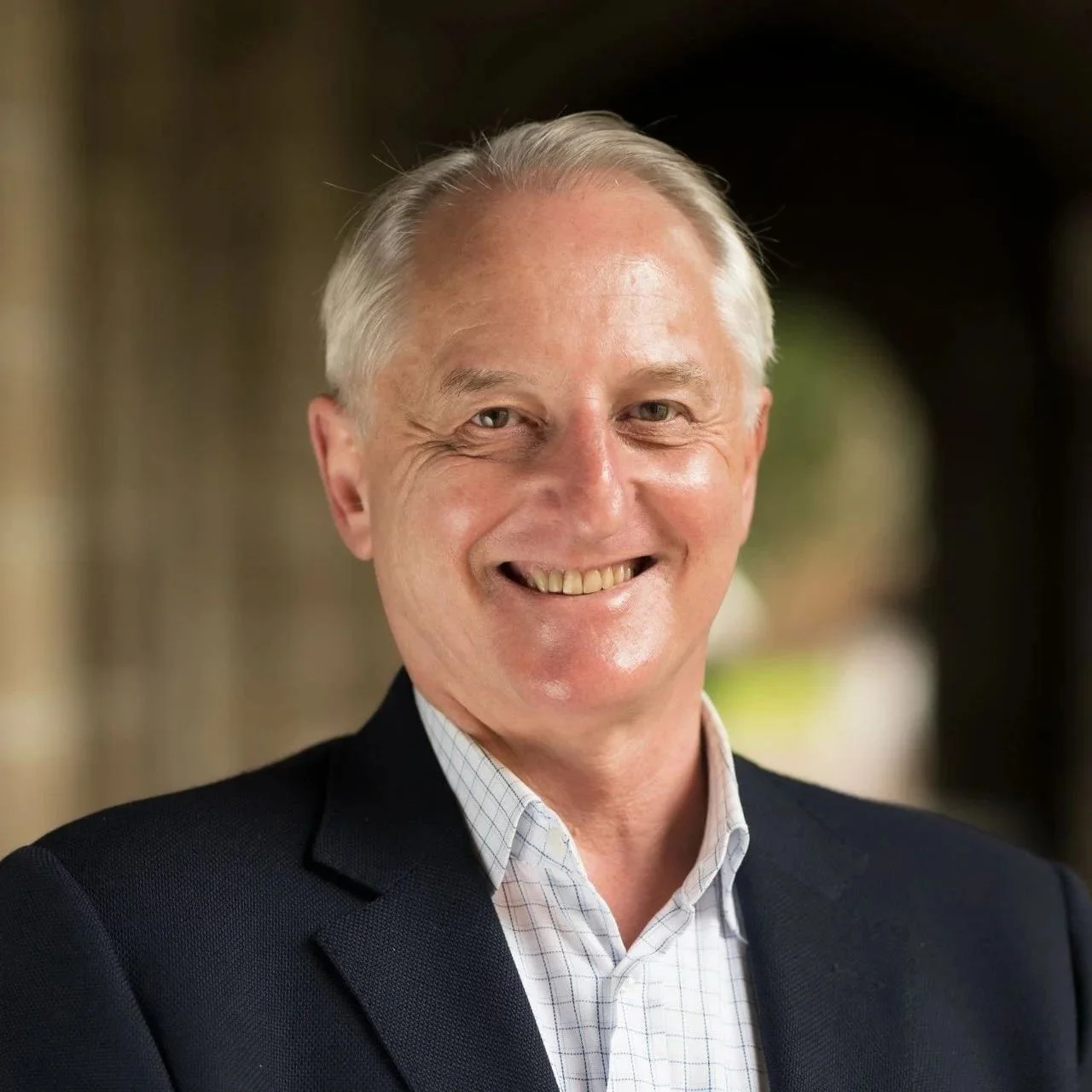
Theoretical physicist Ray Volkas realised early in his career that the mystery of dark matter was central to our understanding of the universe.
Since then, the trailblazing University of Melbourne researcher has developed transformative theories of dark matter that continue to have a far-reaching influence on the field.
But what is now a significant body of work on dark matter started in an indirect fashion.
From the mid-1980s, he was part of a dynamic group of physicists at the university who were exploring general theoretical ideas for physics beyond the standard model, often motivated by aesthetics.
The group conceived pioneering ideas that continue to influence today’s physicists.
One related to ‘portals’ which are interactions between dark matter and ordinary matter.
In the context of a very specific dark matter model called the ‘mirror matter model’, Professor Volkas, working with peer collaborators Dr Robert Foot and Dr Henry Lew, identified the portals that have become extremely important in the study of physics.
“Thirty-five years ago we identified that the Higgs portal, the kinetic mixing portal and the single neutrino portal were really simple but very interesting generic ways that ordinary matter and dark matter should interact.
“I'm very proud of the fact that we had sufficient independence of thought and creativity to come up with those ideas in the first place.”
Professor Volkas is also proud of his pioneering investigations, initiated through joint work with Dr Foot, into the significant coincidence involving the relic densities of ordinary matter, ordinary atoms and dark matter.
“Cosmological observations have established that the mass density of dark matter today is a little more than five times that of ordinary matter. Now, in the cosmological context, it's extremely easy for the relic densities of different particle species to be radically different, to be orders of magnitude different, whereas with dark matter and ordinary matter, the ratio of the mass densities was only about a factor of five in favour of dark matter.
“We argued that this was essentially a hint that perhaps the origins of ordinary matter and dark matter are connected, and that datum about the relic densities today provides an important clue as to the nature of dark matter and how dark matter and ordinary matter are related.”
The questions posed by Professor Volkas and his peers became a widely-explored problem in dark matter theory.
Dark matter was not originally on the radar for Professor Volkas, but he was attracted to particle physics by his curiosity about the fundamental nature of matter and the possibility of physics beyond the standard model.
The mystery of dark matter emerged as a fascinating problem that he wanted to tackle.
“For a long time it was thought that the missing matter - the dark matter - might be massive neutrinos because neutrinos permeate the whole universe, and if you just give them a bit of mass, that would lead to a missing mass issue.
“But then if it was eventually proven in various ways that is an incorrect solution, that it actually doesn't work, because it doesn't fit the astrophysical data in particular, or the cosmological data. It became clear that the issue of the missing mass, the dark matter, really involved completely new physics.”
Alongside his influence in advancing theoretical physics at the university, Professor Volkas is proud of his role as a teacher and mentor.
“To my mind, mentoring research students is one of the major things I do. It is absolutely vital and important, and the most time-consuming activity that I do, and I like it a lot.
“I’m personally proud of the students I have mentored, both PhD graduates, but also masters and honours students who have gone on to fame and fortune, or at least fame, in other parts of the world.
“Of course, these are the people who in coming decades are going to be doing the work when I’ve ceased being capable of doing it, and other people of my generation stop doing it. Those who we have mentored will be picking up the mantle.”
Professor Volkas remains in the thrall of the great mystery that has made up his life’s work so far.
“We have zillions of ways of introducing something that at the moment is successful dark matter into extensions of the standard model of particle physics. All of these different ways of doing it have different experimental and observational consequences.
“What we need to do, and this is indeed what's happening around the world, is a wide spectrum of experiments searching for different kinds of dark matter, including primordial black holes, a non-particle candidate for what dark matter could be.
“We don't know which of these possibilities is right, or even if any of them are right, so we wait with bated breath for one class of experiments to get incontrovertible signals that can only be reasonably interpreted as dark matter, and then that will tell us the way forward.”
“What we need is to live in the hope that one of these classes of experiment or observational campaigns bears fruit.”