
Dark matter researcher at forefront of huge neutrino project in Japan
In the world of physics, it often takes something mind-bogglingly big to detect something tiny.
This is true of the Hyper-Kamiokande experiment in Japan that has been designed to understand subatomic particles called neutrinos – the most abundant type of matter particle in nature.
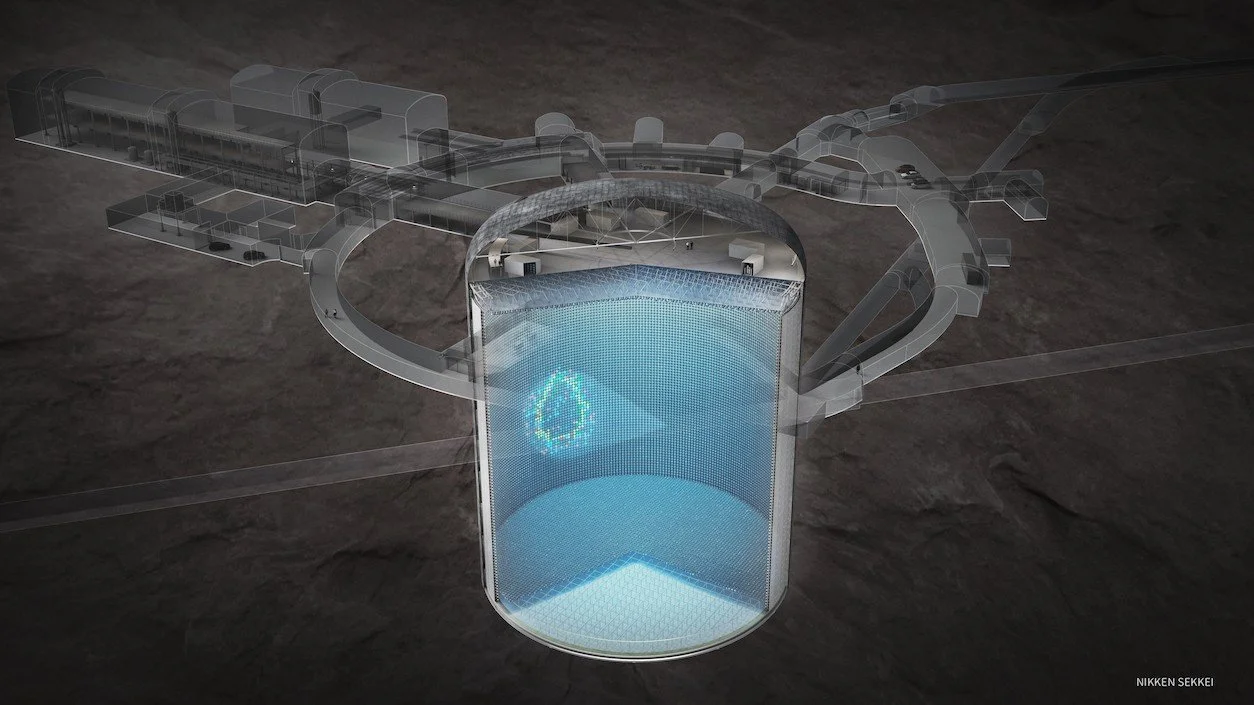
The scale of the detector is daunting, at more than eight times larger than its predecessor, Super-Kamiokande, which itself is the same height as the Statue of Liberty.
Known as Hyper-K, the $1 billion experiment is being built under Nijuugo Mountain in the Japanese Alps, with the help of ARC Centre of Excellence for Dark Matter Particle Physics and University of Melbourne researcher, Phillip Urquijo.
Professor Urquijo is leading the development of the precalibration system for the project and is a member of the Steering and Resources Board and Outer Detector Leadership Group.
“A light year of lead is the distance a neutrino would have to travel to interact with matter, so we need to build a detector that is as big as possible to detect these particles,” Professor Urquijo said.
“The world’s biggest human-made cavern that is 80m high and 70m across has been excavated to hold a cylindrical tank, which will contain 300,000 tonnes of ultra-pure water and 40,000 high sensitivity photosensors.”
In addition to the natural neutrinos that are produced in the atmosphere from cosmic rays, the experiment will detect neutrinos that are beamed from the Japan Proton Accelerator Research Complex almost 300km away.
The photosensors will detect the very weak light generated in the water, acting as a microscope to observe elementary particles and a telescope for observing the sun and supernovas, using neutrinos.
While neutrinos might be tiny particles, their impact on our understanding of the universe could be significant.
“We want to know if neutrinos behave differently to antineutrinos. Hyper-Kamiokande is the first experiment to be capable of such a measurement. This discovery will have a huge impact on our understanding of the observed matter antimatter asymmetry of the universe,” Professor Urquijo said.
Scientists hope the examination of the difference between neutrinos and antineutrinos, and proton decay, that Hyper-K makes possible will be a piece in the puzzle in our understanding of the history of the evolution of the universe.
“These particles are the least well-known of the fundamental particles of nature. We partially know how neutrinos behave, but we don’t know why they have mass, if they violate matter-antimatter symmetry, and some other questions. Understanding their behaviour is a top priority in the field as they offer the greatest potential for impactful discovery,” Professor Urquijo said.
“We expect excavation of the cavern to be completed this year, and the detector will start making observations by 2028.”
The two previous generations of the experiment were awarded Nobel Prizes, and scientists hope that Hyper-Kamiokande achieves similar success contributing to their understanding of the universe.
Professor Urquijo’s work closer to home on the SABRE South experiment that will be located in Stawell is helping inform his role in the Hyper-K collaboration led by the University of Tokyo and the High Energy Accelerator Research Organization.
The SABRE South experiment will also use high-sensitivity photosensors, but instead of neutrinos, aims to detect dark matter.
These two experiments are both located in deep underground laboratories, share similar photosensor technologies, and are both designed to be low in radioactivity to see feint signatures of very weakly interacting particles.
“Both Hyper-K and SABRE South experiments are designed to address some of the biggest questions about the universe - what is dark matter, and why is the universe made of matter and not antimatter? Our team leverages years of work in deep underground detector development and calibration to make an impact in Hyper-K,” Professor Urquijo said.