It is not just the big discoveries that drive Peter Cox in his research into the nature of dark matter, but also the small pieces of the puzzle he is helping to put in place along the way.
Read More
It is not just the big discoveries that drive Peter Cox in his research into the nature of dark matter, but also the small pieces of the puzzle he is helping to put in place along the way.
Read MoreSTEM Women will be hosting their usual three 1-hour sessions, but this time participants will have the chance to meet and chat more informally.
Read MorePhysicist Ciaran O’Hare had his sights set on becoming a musician before astronomy captured his imagination.
Read MoreThe Centre has found a site to store 12 tonnes of liquid scintillator fluid before it is transported to Stawell to be used in the SABRE experiment.
Read MoreDr William Melbourne is working on the development of SABRE, a direct detection experiment. His PhD focussed on the characterisation of the light sensitive detectors used to study interactions in the detector as well as event simulation and reconstruction.
Read MoreSTEM Women is holding a series of Café meetups during May.
The May series of STEM Women Café meetups on May 24, 25 and 27 will focus on the theme of mentoring, exploring ways STEM Women can support others and also be supported in the work of STEM Women.
Read MoreDr Madeleine Zurowski works in the area of experimental particle physics. She completed a PhD at the University of Melbourne which focused on assessing the response of the SABRE detector to backgrounds and different dark matter models. She is a postdoctoral researcher at the University of Toronto, Canada.
Read MoreArt and science might seem to be odd bedfellows, but that is not the case for Australian National University graduate student Raghda Abdel Khaleq. Describing herself as an artistic physicist, Raghda combines her creativity with her scientific knowledge to produce science-inspired art.
Read MoreYiyi Zhong’s area of research is SABRE experimental backgrounds: simulations and measurements of the cosmogenic radiobackgrounds in NaI(Tl), measurements of the intrinsic backgrounds in the crystal powder, and veto liquid scintillator characterization and background measurements.
Read MoreTechnical staff
Read MoreA ground-breaking ceremony was held within the excavated surrounds of the Stawell Underground Physics Laboratory today, deep in the Stawell Gold Mine.
Read More84% of the Universe can't be seen or touched - but we know galaxies would fly apart without the mysterious and little-understood dark matter.
Read MoreThe Centre celebrated the International Day of Women and Girls in Science on 11 February with a series of social media posts featuring remarkable women who study or work in the Dark Matter Centre.
Read MoreProfessor Karl Jakobs (Uni of Freiburg) is an experimental particle physicist with a well-established career using detectors situated at particle colliders.
Read MoreDr Federico Scutti (Swinburne University of Technology) and worked on Heavy Neutrino research with data collected by the ATLAS experiment at the Large Hadron Collider, experimental research for the SABRE dark matter experiment, coordinating the software architecture development and the characterisation of the muon system. He has also been involved in muon flux measurement at SUPL.
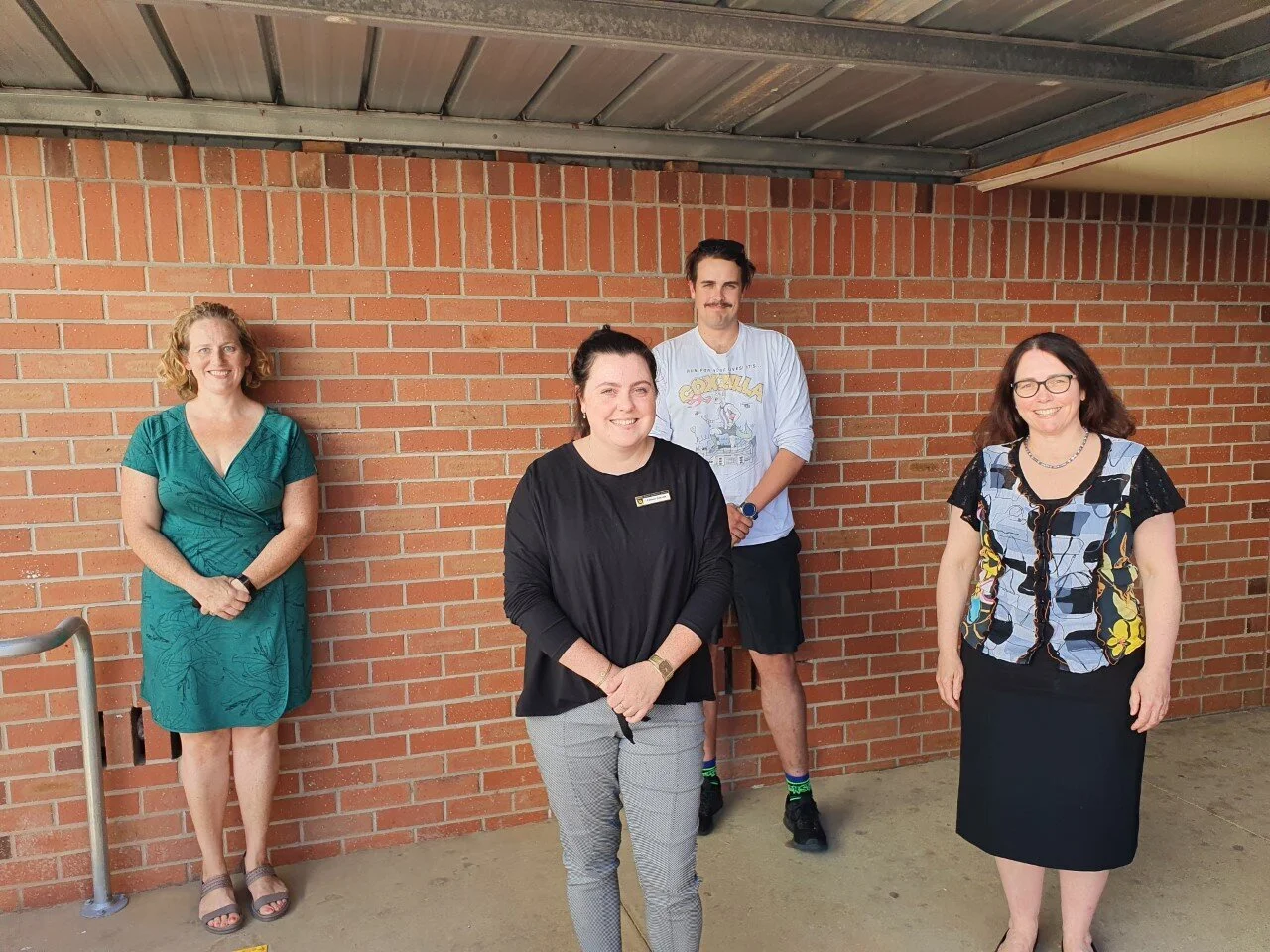
Read MoreStawell Secondary College will have front row access to world-class research in a new partnership with the ARC Centre of Excellence for Dark Matter Particle Physics.
Read MoreProfessor Aidan Byrne (Advisory Board Chair) commenced as the Provost and Senior Vice-President of The University of Queensland in 2016.
Read MoreSue retired from her role as Chief Scientist at the Bureau of Meteorology in 2018, the culmination of a long Bureau career spanning forecasting, research, science/climate/data policy and leadership roles in IT, observations, engineering and science.
Read MoreAs Centre Director, Professor Barberio will be responsible for the Centre’s overall strategic direction and operations, with advice from the relevant Centre committees.
Read MoreProfessor Nicole Bell is an international leader in particle and astroparticle physics. She has broad expertise in dark matter phenomenology spanning direct detection, indirect detection, collider searches, astroparticle physics and cosmology.
Read More