A new approach to searching for ultralight axion dark matter using high-helicity microwave resonators enables more sensitive searches than existing methods.
Read More
A new approach to searching for ultralight axion dark matter using high-helicity microwave resonators enables more sensitive searches than existing methods.
Read MoreCan the superconducting circuits, quantum-limited amplifiers and single-photon detectors being developed for quantum information can help find the invisible matter that dominates the mass of the Universe?
Read MoreThe ARC Centre of Excellence for Dark Matter Particle Physics (CDM) accepts applications for Vacation Studentships from enthusiastic university students with excellent scholastic records who are in the last, or second last, year of their undergraduate or Honours/Masters degree in a relevant field.
Read MoreARC Centre of Excellence for Dark Matter Particle Physics Administrative Officer
Read MoreWenzel brought expertise and equipment, and scientists provided research and a suitable location in new research that aims to help understand the impact of cosmic radiation on equipment used to detect gravitational waves and dark matter.
Read MoreDr John Gargalionis is a postdoctoral research fellow at the University of Adelaide. He works on physics beyond the Standard Model, with interests spanning dark matter, lepton and baryon number violation, effective field theories, flavour physics, and quantum information.
Read MoreJackson Mitchell-Bolton is a PhD student working on axion detection with radio astronomy. He is supervised by Dr Ciaran O'Hare and Dr Manisha Caleb at the University of Sydney, as well as Dr Andrew Zic at the CSIRO Australia Telescope National Facility.
Read MoreThe purest sodium iodide crystals ever seen in Australia, and in any dark matter physics experiment currently underway anywhere in the world, will arrive in the Victorian town of Stawell in coming months.
Read MoreThe first dark matter experiment in Victoria has started taking data in an attempt to detect dark matter or narrow the search for the mysterious particle.
Read MoreThe University of Melbourne Node Administrator
Read MoreGiovani is a postdoctoral fellow at the University of Melbourne, where he works on theoretical and phenomenological aspects of the dark matter problem — spanning cosmology to collider signatures. During his PhD at the Karlsruhe Institute of Technology (Germany), he investigated novel properties of inelastic dark matter models with an emphasis on parity-violating effects."
Read MoreDaniel Marcantonio is a postdoctoral research fellow at the University of Melbourne, working on the SABRE South experiment. The focus of his PhD was developing a search for dark matter at Belle, an electron-positron collider experiment.
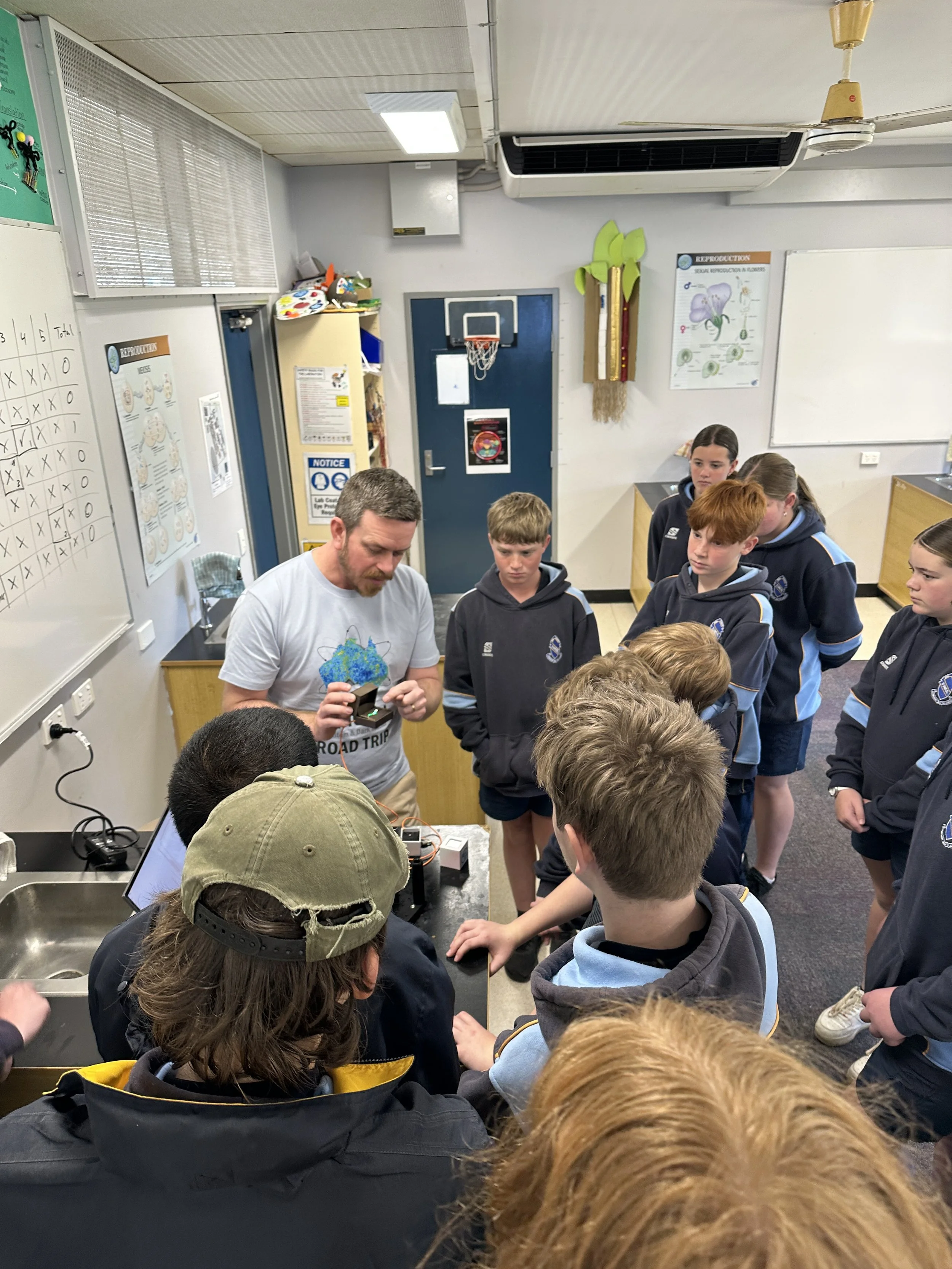
Read MoreThe National Quantum & Dark Matter Road Trip will arrive in Tasmania in 2026 to share the joy and excitement of science with students and communities.
Read MoreThe National Quantum & Dark Matter Road Trip will arrive in Tasmania in 2026 to share the joy and excitement of science with students and communities.
Read MoreDid you know you can take a virtual tour of the Stawell Underground Physics Laboratory (SUPL)?
Read MoreA University of Melbourne researcher has placed the strongest constraints yet on certain rare decays of subatomic particles, narrowing the window for where new "hidden" particles could be lurking.
Read MoreNew research on the direction of dark matter will help scientists build detectors that can distinguish between the mysterious particle they are searching for and background interference.
Read MoreThe Centre is proud to celebrate a remarkable achievement by four Centre members - Director Elisabetta Barberio and CI Alan Duffy, have been elected Fellows of The Royal Society of Victoria (RSV), and CIs Nicole Bell and Celine Boehm have been named Fellows of the Australian Academy of Science.
Read MoreDr Yajing Xing has worked as a postdoctoral researcher at the University of Melbourne on SABRE South. She is now associate professor at Sorbonne University in Paris.
Her primary area of specialisation is the innovative use of liquid xenon time projection chamber technology. This technology has significant applications in both medical imaging and direct dark matter research, making it a truly exciting field to be a part of.
Read MoreTheoretical physicist Ray Volkas realised early in his career that the mystery of dark matter was central to our understanding of the universe.
Read More